Gluttony and the salad problem

When life gives you lettuce, you still want a sausage. Here’s a window on the life of the glutton, and how a few simple techniques can give the salad as much character as any beloved dish.

I am a born glutton. This poses challenges when I want to extend this jolly life for as long as possible, so I can, among other joys, have more time to eat with abandon. Time has only proved itself to be the friend of this committed glutton. By age ten I thought there was nothing better than prawn wontons. At age 21 I was living in Aix-en-Provence, spending money I didn’t have in its delightful market. Back then, I knew all the glorious cheeses I was gorging my way through was a privilege – something only luck and the passage of time have made possible. By the time my 30s ended, I’d eaten a calf's brain, learnt that hot butter was the solution to most things, stunned a live lobster, tried puffin sashimi, and swamped my kitchen with gallons of fat from a roast goose.
Every year has offered up yet another gastronomic landmark and it only makes me want to discover more. But it comes with problems, which calls for an unwelcome reference to physics: in the way that an object’s mass holds it back from ever reaching the speed of light, so my passion for saucisson will hold me back from living long enough to enjoy more saucisson come 2080. Let’s call this glutton inertia. Like many tedious bores, I took up running once I could no longer trust my metabolism to disguise the saucisson habit. I ran so I could eat without guilt.
‘Salad has forced me to explore the palate more consciously than hot food. I can’t rely on bones, collagen and warm fat to deliver flavour.’
Summer salad season is here, a thorn in the side of this butter junkie. It reminds me I should at some point put down my hogget and tuck into some rocket. For the record, I do love a salad. I love the hit of bitter freshness to the palate. It makes me feel good about myself – this doesn’t need documenting, because it’s the salad’s raison d’être. But for the adventurous eaters it feels limiting too. There are some lovely salads, but somehow I don’t think many of us dedicated gastronauts would choose salad for our last supper.
Salad has taught me a lot of life lessons. I’ve approached it like a problem to be played with: how do I not feel like I’m compromising when I eat a salad? How do I make it an event or satisfy my need for richness? Cold food doesn’t impart flavour in the same way hot does. Salad has forced me to explore the palate more consciously than hot food. I can’t rely on bones, collagen and warm fat to deliver flavour.
Salad works best not when it soothes but when it excites the palate. Starting with bitter leaves as the base, the challenge is then, how might you bring balance? Not even the most committed negroni and black coffee drinkers will want a mouthful of undressed chicory. In this radicchio caesar I took on exactly that challenge, suspecting the anchovy, parmesan, roast tomatoes, capers and sherry vinegar would each pull the palate in the direction of savoury, sweet and sour.
‘Maillard is powerful in a salad – it turns it into a robust meal.’
This radicchio recipe reveals the magic of charring a lettuce or cabbage face down. For the food nerds: the maillard effect happens when proteins and sugars heat up and bond, forming a delicious brown crust. It’s different from caramelisation, which is sugars bonding with sugars. It’s why we brown the meat and the mirepoix before we make a stew. It’s why we don’t overcrowd the pan when searing: the surface has to go safely over 150° for it to work and evaporation stops that. At one point in my learning, I got so obsessed with maillard that I tried to do it with everything I was eating, ruining a perfectly good cheese in the process.
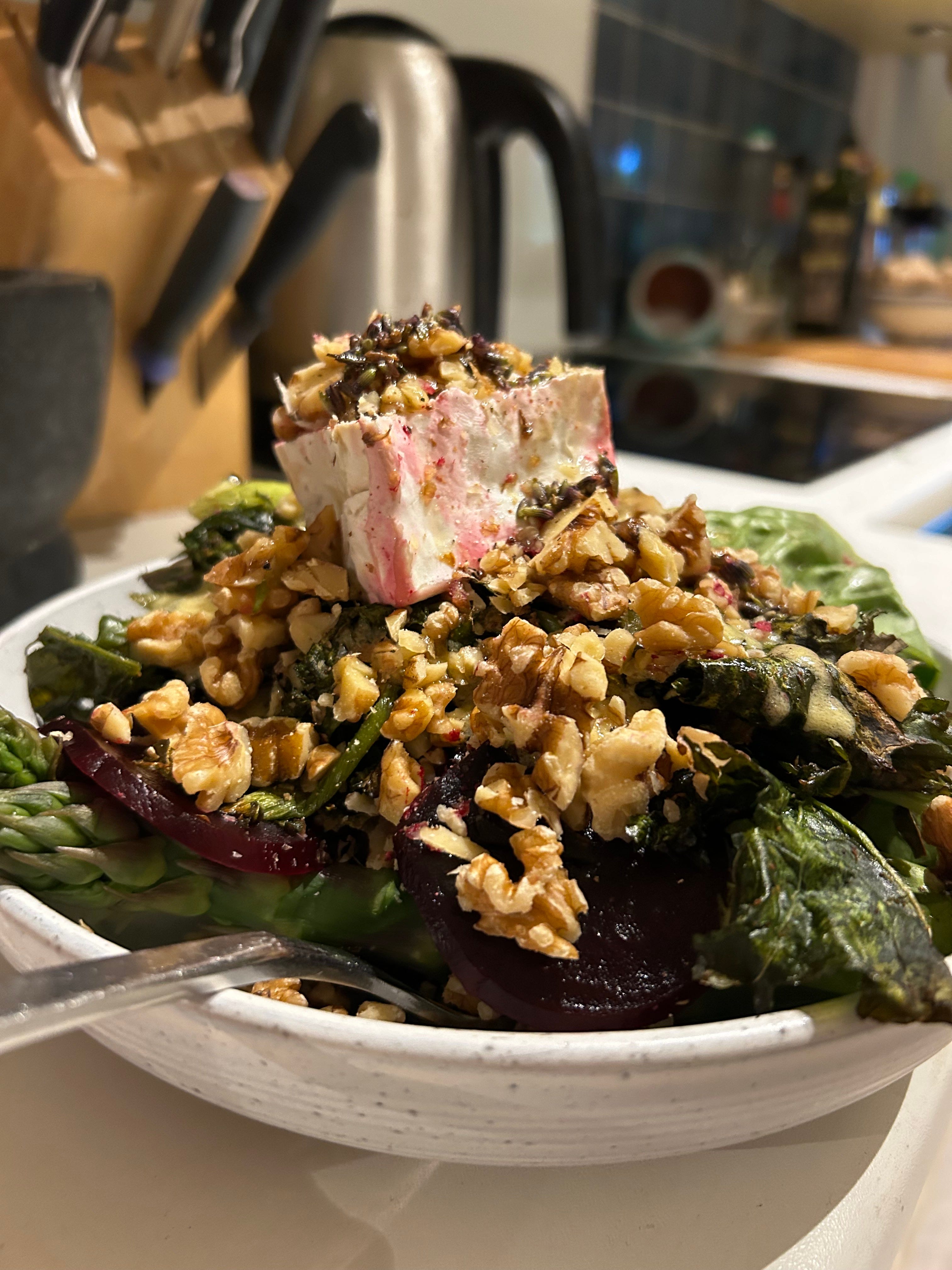
Maillard is powerful in a salad – it turns it into a robust meal. If you sauté some chorizo or pancetta, you’ve maillarded your salad. Char a sprout? Maillarded. Roasted a cauliflower, toasted a pine nut or crouton? Maillarded. I must stop trying to make maillard a verb.
Salads come into their own in how they delight with continuously changing flavours, textures and colours. Comfort food staples like spag bol or chicken soup cower in the light of a salad that takes you on a journey of discovery, from bitter leaf to sweet tomato, to earthy asparagus, to a pungent goat’s cheese, to a crumbling walnut. While a curry delivers a (nonetheless delicious) uniform flavour, no mouthful of salad is identical. In fact I’ve taken to serving a salad with most curries I make. Asian salads and their zippy freshness offer the perfect complement to a rich curry or crispy duck.
There’s a formula to my salads. I look for heft from a sturdy vegetable like potato, beans or asparagus to complement the dainty lettuce. I lean on anchovies, pancetta, cheese or olives to for the saline foil to the bitter leaves and hit of savoury. And I always add a nut to a salad for textural character.
Here are a few ways I’ve been exploring salads. Comment if you’d like me to write a recipe – I’ll make this a feature of my posts if there’s interest.
Skate wing, blood orange and fennel.
Cauliflower and blue cheese salad
Great post! I’d love a recipe so I can try one for myself.
Great writing, thank you.